
The Risk Ranking Process is a screening step Yinka Huwunline applies to every proposed harvest block before it can move ahead.
What it does
- Screens every new proposal as a first filter.
- Scores risk to our values using our own information.
- Produces a record of risks the licensee must respond to in co-planning.
- Flags where deeper planning and Keyoh direction are needed.
Risk ranking is not a decision; Keyoh and leadership still decide what happens on the land.
What the screening process looks at
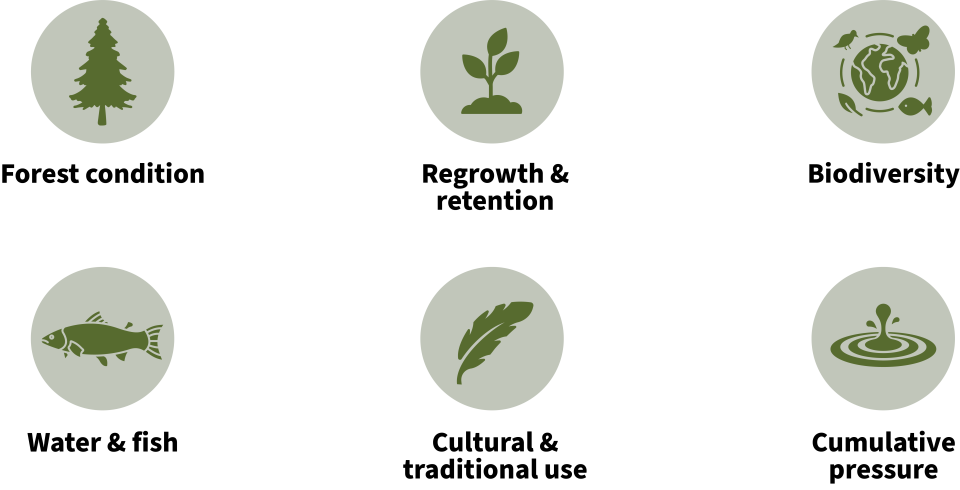
- Forest condition: primary or secondary forest, species, mix, how much of the stand is alive, forest health pressures
- Regrowth & retention: Density of young trees already growing, what can be kept standing so harvested area is not bare.
- Biodiversity: Overlap with Biodiversity Management Areas built from 30+ ecological and cultural attributes
- Water & fish: Watershed condition, fisheries-sensitive areas, spawning grounds
- Cultural & traditional use: Known traditional use sites, trails, and reserves in the Land & Stewardship Plan
- Cumulative pressure: How much has already been taken from the surrounding area, so each new block is weighed against the whole, not judged alone.
Harvest priorities
- Higher priority for harvest
- Stands already hit by disturbance
- Stands past their prime
- Areas with enough young regrowth underneath for the forest to recover
- Higher risk
- Live, healthy forests
- Older & primary forest
- Anything overlapping water, fish, wildlife, or cultural values
How the scoring works
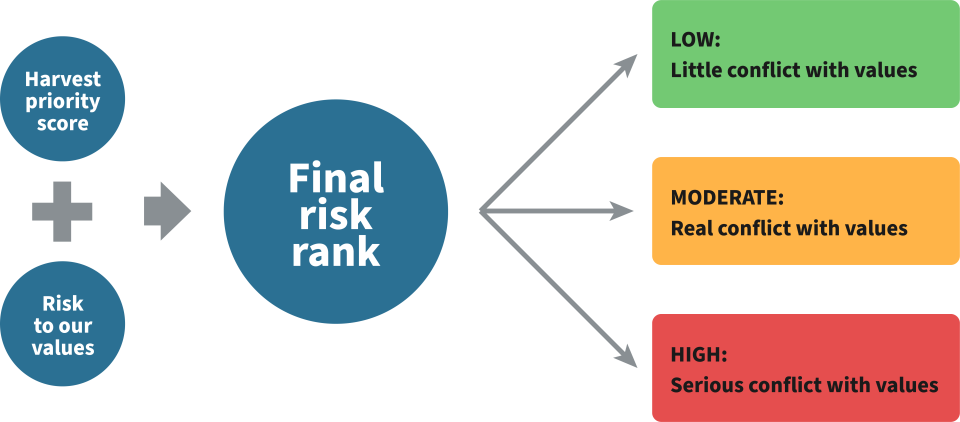
Harvest priority score + Risk to our values = Final risk rank
Risk rankings
- Low: Little conflict with values. Co-planning and Keyoh review can move relatively quickly.
- Moderate: Real conflict with values. More time, mitigation, and Keyoh direction needed before consent is possible.
- High: Serious conflict with values. Intensive work required and some block should not proceed.
Potential outcomes
Proceeds, with conditions
- Low conflict with values
- Licensee’s commitments are written into co-planning record
Redesigned first
- Boundaries pulled back from water or old forest
- Retention increased, roads rerouted
- Block changes shape until the risk comes down
Restoration attached
- Harvest tied to restoration work
- Rehabilitating old roads, replanting, repairing habitat
Does not proceed
- Some places are simply no-go
- Rank will be recorded in writing and reasoning stands for next proposal